Showing posts with label spices. Show all posts

Thursday, December 25, 2008

Ali's Kitchen: Swedish Holiday Treats

Happy Holidays!

I am ALL about my [admittedly meager] Swedish heritage this year. I may only be about 1/16, but I know the name of my most recent Swedish ancestor (Maria Pollan, née Larson), so that counts for something, I figure. My Nana, who has had a very tough year, always identified with her Swedish heritage, if not necessarily in the kitchen. It'll be a fun, and for me meaningful holiday exercise to attempt a few traditional Swedish recipes.

A word about Swedish holidays:

St. Lucia's Day
Lussekatter
On the feast day of St. Lucia, little Swedish girls (and Norwegian girls and Danish girls and Italian girls and a bunch of girls) dress up in white gowns with red sashes, wear wreaths with burning candles on their heads (yeah, really) and pass out the Christmas presents. You know this if you, like me, had the American Girl Doll Kirsten Larson, who was a plucky Swedish immigrant in 1854 (or something). Kirsten had a St. Lucia's Day outfit, and I think the outfit even came with a little plastic lussekatt, the saffron bun baked and eaten on St. Lucia's Day night. It all sounds terribly cute until you consider the fact that the wreath with candles is supposed to symbolize the *fire that wouldn't burn St. Lucy after she was sentenced to death*. Isn't that festive? I pulled the below recipe from a website to which I will NOT link, because they had all kinds of typos and it was just generally an "off" recipe, so I had to modify.

Jul/Midwinter
Glögg
The Yule is celebrated on December 24th in Sweden, though it's also tied to the old Germanic pagan festivals related to the Winter Solstice on December 21st. This is the day when Swedes tie one on and really enjoy their version of spiced mulled wine: glögg (pronounced something like "glug"). There are so many various recipes for glögg that you can feel free to assemble the main ingredients and use them in whatever proportions please you best.

Any Swedish Holiday At All
Köttbullar
Swedish. Meatballs. 'Nuff said. Always, always served with lingonberry preserves. Seriously, in Sweden if you try to eat köttbullar without lingonberries? They will arrest you and beat you. I've provided the classic preparation from Fresh Direct, but I'll outline my method, too.

LUSSEKATTER
(Saffron Buns)
INGREDIENTS
1/4 teaspoon saffron threads 1 cup milk 1 tablespoon yeast 1/2 cup sugar 4 ounces (1 stick) unsalted butter 5 cups all-purpose flour 1 teaspoon salt 2 large eggs, beaten 1 beaten egg white for egg wash
PREPARATION
Pound saffron threads to break down strands. (Ali note: Or just tell the people reading your recipe to get saffron powder, jeez.)
In a small saucepan, heat milk to lukewarm.
Mix yeast with 1/4 cup milk and 1 tablespoon sugar. Set aside.
On low heat, melt butter in saucepan with milk. Add crushed saffron. Let cool.
In large bowl, mix together flour salt and remaining sugar.
Stir yeast into cooled milk mixture. Mix into dry ingredients, beating to mix well. Add beaten eggs.
Knead in bowl for 5 - 7 minutes. (Ali note: Kneading in the bowl is somewhat confining. After the eggs are mixed in well, feel free to jump right to your floured board, or counter, as the case may be.) Turn onto floured board and knead another 7 - 8 minutes. (Ali note: If it's sticking to your little fingers, try adding a bit more flour to your board or counter; that’ll mix in and firm up the consistency a little. Conversely, if it's too DRY to stick to your little fingers, sprinkle some water on as you knead 'til it's about the right texture - something like Play-Doh.) (Don't forget to wash your hands before you start this recipe, including under your filthy little fingernails, you scab.)
Put dough in lightly greased bowl, turn to coat all sides, cover and put in warm, draft-free place to rise for about 1 hour.
When dough has risen, knead lightly to push out air and divide into small pieces (about 10-12). (Ali note: Whoever wrote this recipe was high if they thought this amount of dough makes 10-12 of these things, the size of which would cook in 15 minutes. I ended up with closer to 18, and still needed a little longer in the oven.)
Using the hands, roll each small piece into a strip about 8 - 10 inches long. Shape each strip into an 'S' or a figure 8. (Ali note: For authentic look, place a raisin or currant in the dimples of each bun.)
Place on lightly buttered cookie sheets. Cover with clean cloth and let rise again, about 1 to 1 1/2 hours.
Preheat oven to 375°F.
When dough has risen, brush lightly with egg white.
Bake in preheated 375° F oven for 15 minutes, or until lightly browned (which was a bit longer than 15 minutes).
Let cool on wire rack.

GLÖGG
(Um... Glögg)

As noted above, you can make glögg in nearly any way you choose. This is my favorite amalgamation:
INGREDIENTS
1 bottle dry red, such as Cabernet Sauvignon
1 cup brandy
3-4 cinnamon sticks
6-8 cloves
1-2 teaspoons ground cardamom (ideally you use 3-4 whole caramom pods, cracked, but good luck finding those in most grocery stores)
1 tablespoon dried orange peel (or the peel of 1 whole orange)
1/3 cup sugar (ideally brown, but if you're scrimping and just have white, go for it!)
Currants or raisings
Almond slivers
PREPARATION
Simple: Heat. On the stove. For at least 45 minutes. Don't let it reach 170 or so (that means keep it just at steaming and below simmering), unless you want nonalcoholic glögg. A clean meat thermometer is handy for this purpose.
Put a small handful of currants (or raisins) and almond slivers at the bottom of each glass.
Pour the glögg into your glasses through a sieve to strain out the cloves and such, and enjoy.

Skål!

KÖTTBULLAR
(Swedish Meatballs)

I made this with 2 lbs. ground beef (you can also use veal with the beef, about 1/3 to 1/2 the total amount of meat; that's how the restaurants usually do it) instead of 1 1/3 lbs., which is what the original recipe called for. Watching *me*, the literature nerd, try to figure out that sort of conversion? Must have been priceless. I had to appeal to my civil engineer father for guidance. This is what he came up with:
INGREDIENTS
1/2 cup plain breadcrumbs
1/2 cup milk
1 medium yellow onion, finely diced
1 egg plus 1 egg white
2 lbs. pounds lean ground beef (But for goodness sake, not too lean.)
1/2 tsp salt
1/4 tsp pepper (Most recipes call for white pepper, but this one doesn’t differentiate; I used white)
1/2 tsp allspice
1 tbs butter
1 tbs extra-virgin olive oil

PREPARATION (The "real" way)
Soak breadcrumbs in milk for 5 to 10 minutes until the liquid is absorbed.
To a bowl add onion, egg, ground beef, soaked bread crumbs, all spice, salt and pepper.
Mix all the ingredients together with your hands and shape the meat mixture into small balls, less than an inch in diameter. If the mixture starts to sticks to your hands, wet them with cold water.
Heat a skillet with butter and extra virgin olive oil.
Sauté the meatballs in 3 or 4 batches, turning them frequently to keep the meatballs from sticking. Drain them on paper towels.
Drain the excess olive oil and scrape off and discard any browned bits of meat that may be sticking to pan after the meatballs are done.
To the same pan add butter and flour and stir until it browns.
Quickly add a can of beef stock and bring to a boil, stirring constantly until gravy thickens.
Remove from the heat and serve immediately with the meatballs.

PREPARATION (The weenie way)
Preheat the oven to 400°F.
After you've formed the meatballs as described above, place in a lightly greased, uncovered Pyrex dish.
Cook for about 10-20 minutes, depending on the size of the meatballs; eyeball it and do a touch-test to test for doneness. Rotate halfway through so the entire sphere gets browned as it would have in a frying pan.
Remove from pan, and drain on paper towels; keep warm after draining.
Use pan scrapings to make gravy as described above, adding extra beef broth or stock to increase volume as necessary.
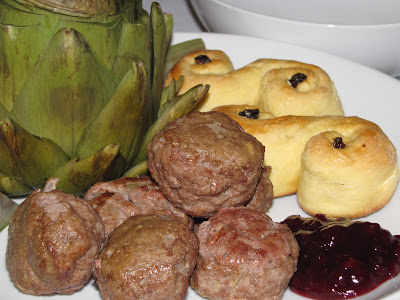

(Sorry for the freaky lighting. Still getting the hang of this new camera!)

Enjoy your Swedish feast, you crazy Vikings! } :- )

(That's clearly a Viking helmet, BTW.)

(Shaddup.)

Wednesday, November 19, 2008

Ali's Kitchen: Potato and Leek Gratin With Cumin

It's cold. My head hurts. It's the perfect time for this dish. This recipe for potato and leek gratin with cumin comes directly from the "Recipes for Health" feature of the New York Times Health section, ironically not the Dining & Wine section. At first glance you (depending on your cultural baggage) might think, "Potatoes? Gratin? What is this doing in 'Recipes for Health?'" Well, here's why:

Cheese isn't bad for you! Neither are potatoes! Calcium and protein. Fiber and potassium. THE. END.

Well, not The End, obviously, but let's point something out: This recipe uses less than 1 cup of Gruyère, in a dish meant for 6-8 people. You can use even less cheese, if you like, and you'll still get the creamy effect. That's hardly a lot of dairy fat. And, since this is from the Health section, they've substituted the cream that's in many gratins for lowfat milk. Works just fine everytime, and your tummy (if it's sensitive) will thank you. Herewith, the text of their recipe, interspersed with pictures from Carlita Canon:

INGREDIENTS
1 garlic clove, cut in half
1 tablespoon extra virgin olive oil
1 pound leeks, white and light green parts only, cut in half lengthwise, sliced and rinsed of sand
Salt and freshly ground pepper
1 teaspoon cumin seeds, lightly toasted and crushed in a mortar and pestle or a spice mill (I had cumin seeds as well as ground cumin, but not a mortar/pestle or spice mill. I just used the ground cumin.)
2 pounds russet potatoes or Yukon golds, peeled if using russets, scrubbed if using Yukon golds, and sliced 1/4 inch thick
(I'm using red potatoes because for some bizarre reason, that's all the grocery store had. I think I also bought more than 2 lbs - our grocery doesn't have a scale, oddly enough - because this practically overflowed my 2.2 lb casserole.)
3 ounces Gruyère cheese, grated (3/4 cup, tightly packed)
2 1/3 cups low-fat milk

PREPARATION
1. Preheat the oven to 375ºF. Rub the inside of a 2-quart gratin or baking dish with the cut side of the garlic clove. Brush lightly with olive oil.
2. Heat the remaining olive oil in a wide, heavy nonstick skillet over medium heat and add the leeks. Cook, stirring often, until tender, for about 5 minutes. Add 1/2 teaspoon salt and freshly ground pepper to taste and stir in the crushed cumin seeds. Stir together for half a minute and remove from the heat.
3. Place the potatoes in a large bowl and season generously with salt and pepper. Add the leeks mixture and half the cheese, and toss together. Arrange in the baking dish in an even layer. Pour in the milk.


Place the baking dish on a baking sheet and place in the oven.
4. Bake the gratin for 45 minutes, checking after 30 minutes and pressing the potatoes down into the milk with the back of a spoon. At 45 minutes, remove the dish from the oven and again press the potatoes down into the liquid. Sprinkle the remaining cheese over the top and bake for another 30 to 45 minutes, or until nicely browned. Remove from the heat and allow to sit for 10 to 15 minutes before serving.

There you have it! In retrospect, I would add that:

- Putting a cookie sheet under the pan is helpful, in case the milk boils over in your small casserole;
- Possibly cover the top with aluminum foil for at least part of the early cooking so it doesn't get too brown. The color doesn't make a difference in the AWESOME taste, but if you need to serve this to someone other than your living partner, it might be a nice touch.


The article means this recipe for a vegetarian main dish , but we are having it with sautéed chicken breasts, whipped up while the gratin is cooling. Simply:

1. Rinse, pat dry, lightly salt and pepper the chicken, etc. and so forth with your basic prep.
2. Dredge the breasts through some milk, then through some flour mixed with coriander, paprika, and garlic powder, just to keep things interesting.

Coriander and paprika are fun with the cumin, but use your own favorite spice here.

3. Preheat some olive oil or butter or both in the UNWASHED pan you used for the leeks.

4. Sauté about 5-7 minutes per side (totally depends on the size of the breasts).

(If you use GARGANTUAN chicken breasts like some of us, then when both sides are brown and they STILL aren't done, take the gratin out to cool and put the chicken in the oven in its place, in either a 400-degree-safe pan, or in another casserole. If your chicken breasts are big enough that 8 minutes per side didn't do it in the pan [these are the Frankenstein breasts about whose growing process I'd like to keep in the dark], then at least 10 minutes still at that 375ºF should do it. If you're hopeless at cooking poultry, like I am, then a meat thermometer always helps.)


Boom. Dinner. Le yum yum.

Sunday, July 13, 2008

Ali's Kitchen: Shellfish with Chipotle and Tequila

I'm REALLY excited about this one because the picture is REALLY PRETTY, and as we all know, presentation is half the battle. See?


I didn't take this picture. Whoever did, please don't sue me. I love you; you're an awesome food photographer.

Here's the gist from Cooking Light:Ingredients1 teaspoon olive oil Cooking spray 1 1/2 cups chopped yellow onion (about 1 large) 1/2 cup chopped red bell pepper 1/2 teaspoon freshly ground black pepper 1/4 teaspoon kosher salt 4 garlic cloves, minced 1 3/4 cups water 1/4 cup tequila 2 tablespoons fresh lime juice (about 1 lime) 1 teaspoon ground cumin 2 teaspoons tomato paste 1 1/2 teaspoons chopped seeded chipotle chile, canned in adobo sauce 1/2 teaspoon dried thyme 1/2 teaspoon dried oregano 1/2 teaspoon ground turmeric 1 (14.5-ounce) can no-salt-added diced tomatoes, undrained 1 (14-ounce) can fat-free, less-sodium chicken broth 24 littleneck clams 1/2 pound sea scallops 1/2 pound peeled and deveined medium shrimp 1/4 cup chopped fresh cilantro 1/4 cup chopped green onions Preparation1. Heat olive oil in a Dutch oven coated with cooking spray over medium-high heat. Add yellow onion, bell pepper, black pepper, and salt to pan; sauté 5 minutes or until tender. Add garlic; sauté 2 minutes. Add 1 3/4 cups water and next 10 ingredients (through chicken broth) to pan. Reduce heat to low, and simmer 12 minutes, stirring occasionally. 2. Arrange clams in a steamer. Cover and steam over boiling water 8 minutes or until shells open. Discard any unopened shells; set aside. 3. Add scallops and shrimp to tomato mixture; cook 7 minutes or just until done. Ladle 2 cups soup into each of 4 large shallow bowls; top each serving with 6 clams, 1 tablespoon cilantro, and 1 tablespoon green onions.

Accompanying this main dish will be some more couscous, and a simple green salad (tatsoi) with the excess green onions.

So, that's what we're aiming for. Ambitions are high. Hopes are... a little tepid, since I don't actually have the "chipotle peppers in adobo" which this recipe calls for. I have ground chipotle powder. At my dad's suggestion (he is a masterful cook), I'm halving the measurement of "chipotle" whatever, which makes this about 1/2 tsp. chipotle pepper I'm using. Other alterations include SHALLOTS instead of yellow onions (why buy more when you already have something vaguely similar in this crappy, crappy economy?); bottled lime juice instead of fresh limes (ditto); chicken broth that I need to get rid of; not having a steamer for the clams; and some shrimp that really, REALLY needs to come out of the freezer, which was the main reason for cooking this recipe, rather than the other pretty ones in the newest issue of Cooking Light. I would also like to take this moment to advocate buying local food and produce. The other main reason I went with this recipe was that our "local dayboat" littleneck clams were on sale. They look AWESOME. At this point of typing I obviously haven't eaten any, but they LOOK great. And they're SO much easier to clean than mussels. I had to debeard ONE clam, as opposed to every mussel I've ever cleaned. I'm also going with our "local dayboat" (which here means Long Island, probably) scallops, which were similarly reduced by the wonder that is Fresh Direct. Cry for not having it. CRY, I TELL YOU, FOR IT IS AWESOME. Except that it doesn't seem to have chipotle peppers canned in adobo sauce at the moment. Oh well. Here we go!

This is one of those recipes that takes A. Lot. Of. Prep. If you are not, for instance, Courtney and never learned how to chop produce professionally, this may take you a long time with all the chopping of the peppers and the onions and the garlic and cilantro and the other onions. And also the measuring of the spices and the tomato paste, etc. Then there's the cleaning the clams (again, not as long as mussels) and the peeling and deveining/cleaning the shrimp.

Shrimp Tip: If you suck at cleaning shrimp, or just don't have a little shrimp de-veiner thingy, just butterfly it (slice it down the back, that is), and, again, if you're like me and can't ever managed to get the poop-or-intestine-or-whatever-that-dark-stuff-is out of the shrimp with the knife itself, a BAMBOO GRILLING SKEWER is great.

Interesting Shrimp Fact: The shrimp I'm using have their poop-or-intestine-or-whatever-that-dark-stuff-is on the BOTTOM. ... WHAT? Who ever heard of that? Also, they're a little freezer burned, but that's not exactly their fault, is it?

So, here are all your ingredients, nice and chopped and prepped, and hopefully you haven't sliced off any of your fingers with your sharp J.A. Henckels knives, which rock hardcore:

Bonus points for me smelling out which square of Saran wrap matched up with which prepared ingredient after this photoshoot

For the clams, since I don't have a steamer, I'm using some of the excess chicken broth mixed with water to steam. Why not, right? This could all go horribly, horribly wrong.

HERE WE GO:

We've already encountered our first unintended alteration: In my frenzy of preparation, I accidentally mixed the salt and pepper in with the other spices, while the recipe calls for them to go in with the olive oil FIRST. No idea how this will affect the food from a chemical/flavor standpoint. Maybe not at all, maybe we'll end up order pizza. [Discovery Channel narrator's voice]

Second problem: WHY DID I PRINT OUT THE RECIPE THIS SMALL?!

Um... wut?

Let's see what's ahead.

So, if you're like me, your stove has a terrible inequity (I almost wrote "iniquity") of heat distribution. This makes it tough to simmer, fry or sautee. But I'm doing my best to simmer the veggie broth for about 12 minutes, over low heat, stirring occasionally.


Since I don't want to overcook the clams, I'm not steaming them yet, but I am pre-heating the steaming liquid so I can cook the clams at basically the same time as the shrimp and scallops. Also, my couscous has already been cooked in the microwave.

While the clam and scallop-shrimp liquids are heating, you can pass your time watching Robin Hood: Men In Tights.

Always diverting

Okay, now we're putting on the shrimp and scallops... and the the clams...

Smells... SPICY. I hope my dad's estimate of the canned-chipotle-to-powdered-chipotle was accurate, otherwise K will be very happy and I will be drinking even more wine. (... It was a stressful day, for the LAST time.)

Okay, TASTES spicy too. Wow. Heat. Yikes. I guess I have no reference for using the chopped canned chipotles peppers vs. chipotle powder, but JEEZ. SPICY.

Anywho, this is what mine turned out looking like:

Looks redder than the recipe photographed for the magazine. On the plus side, look how FAT and JUICY this "local dayboat" clam is:


I'll be making this again, but probably with less freezerburned shrimp and LESS COOKING TIME OVERALL, because this dude lied, and all the seafood should have withstood much less heat. Although the fat clams emerged unscathed. See?


I'm sorry. That's not a clam; it's a feline sous chef sitting in the recycling pile. How terribly misleading of me.

Wednesday, July 9, 2008

Ali's Kitchen: Salmon Fillet en Papillote with Julienne Vegetables

Sorry to post twice in one week (annoying), but I'm excited about this one...

I was watching Food Network, which I am not wont to do. I was waiting for Throwdown with Bobby Flay to come on to see Amalah make her Basic Cable debut. I tuned in about half an hour early because TV has superseded most other habits in our house, and there was Alton Brown on Good Eats, which has disturbingly behind-the-times graphics, and I wish someone would tell their producers.

The episode was all about pouch cooking, which sent me into the euphoria of memory that is Reminiscing About Sleepaway Camp. What a great freaking place. GOD I LOVED IT. I was terrible at Arts & Crafts and never took it, but I was GREAT at "Outdoor Survival," which, when the Born Agains took over from the lesbians my last year there, became "Outdoor Living," which is just NOT as appealing for those of us who are obsessed with The Road and its ilk, but I took it anyway, even though we just ended up making herbal masks and learning that when you put cream or foundation on you're supposed to apply UP, against gravity, so you don't become a wrinkly, saggy wife for your dashing husband because he is the Priesthead in your Born Again family. Or something. ANYWHO. Every year in Outdoor Survival we had an actual camp-out night where we would do such rugged things as take a big white van to a field about 15 minutes away, set up easy-to-set-up tents and CAMP. At CAMP. GO FIGURE. This camping night always, ALWAYS involved (before the S'mores) Hobo Dinners, which basically consist of a choice of: pre-cooked ground beef or tofu, diced potatoes, onions, peppers, Worcestershire sauce, and cheese. IT WAS THE BEST THING EVER. Thus began my love of food cooked in pouch form. (Please see: Samosas, Empanadas, Tamales, Stuffed Potatoes, Calzones, et al.)

Well, this meal is not that. We're not 11 anymore, and we're not in Alabama burning lots of calories climbing rocks and canoeing anymore, so we need a slightly less calorie-dense selection for our average work-from-home New York City Wednesday night. Hence, salmon and veggies. I'm adding MORE veggies, because it's ME, and I'm adding more spice (coriander and pepper) than is called for, because, again, HELLO, look who is typing this.

Here we go:
Food Network "Good Eats," courtesy of Alton Brown
Ingredients (which we double, since we're making 2 pouches):
1/3 cup julienned fennel bulb
1/3 cup julienned leeks, white part only
1/3 cup julienned carrots
1/3 cup julienned snow peas
1 teaspoon salt
1/8 teaspoon freshly ground black pepper
1/8 teaspoon whole coriander seed, ground fine
1 (8-ounce) salmon fillet, pin bones removed
1 orange cut into wedges with white, pithy membrane removed
1 tablespoon dry vermouth
Some modifications on my part: Obviously, I'm using more spice and less salt, because that's my M.O. Also, we don't have vermouth. I'll be using a little white wine (vermouth is, after all, just fortified wine with spices, so it must be sort of close, right?). Lastly, we did BUY snowpeas with this batch of groceries, but we are not USING them here. We'll probably eat them with hummus.

Now, Alton says to:

Take a 15 by 36-inch piece of parchment paper and fold in 1/2 like a book. Draw
a large 1/2 heart on paper with fold of paper being the center of the heart. Cut
out heart and open. Lay fennel, leeks, carrots, and snow peas on parchment in
center to 1 side of fold. Mix together salt, pepper, and ground coriander.
Sprinkle vegetables with 1/2 of salt, pepper, and coriander. Lay salmon on top
of vegetables and season with remaining salt, pepper and coriander. Top with the
orange wedges and sprinkle with vermouth. Fold other side of heart over fish and
starting at top of heart shape, fold up both edges of parchment, overlapping
folds as you move along. Once you reach the end tip, twist several times to
secure tightly. Place on microwave safe plate and cook for 4 minutes, on high in
microwave, or until fish reaches 131 degrees. Open parchment carefully and serve
for a complete meal.
I disagree that this is a complete meal. We're adding some couscous, because we still have a bunch in the pantry. Also, I shan't be using the microwave, since it would be annoying to do ONE, then the OTHER. We're doing it in the oven at 425 for 12ish minutes.

Let's get started!

First, let's admire all the produce:

Green, lush, and DIRTY. WHY IS IT SO DIRTY? Oh yeah, it's organic. I didn't actually order organic; they apparently ran out of non-organic because everyone's trying to save money. (In that vein, I would like to point out that I'm using U.S. farm raised salmon, when I'd really prefer to use wild due to its superior muscle tone and protein-to-fat ration. BUT IT'S TOO PRICEY, DAMMIT.) (And I have no idea which one has more mercury vs. which one has more amino acids, but I do feel that, often, we're told to do one this for the Earth and a totally different thing for our longevity. It DOESN'T. MAKE. SENSE.)

Ahem hem. Also, these oranges look like they were kidnapped from their tree home a little early. They're pretty green. Check them out when compared to green and orange produce. Which one do YOU think they more closely resemble:

Mmmmm they actually taste great! Better than they should, by rights, being July oranges and all. I'm still a little skeptical about their use in this dish, but Mr. Brown is the one making lots of money off telling people how to cook, so...

As far as julienned vegetables are concerned... well... my primary association with julienned anything is Aladdin. And it looked pretty easy in that, but that guy had some kind of magical chopper he was trying to pawn off on his audience, so... I'm thinking I might have to watch my fingers using an actual knife, and that it might take a little longer than 2 seconds of animation cels. A few notes on these vegetables:

Now, I love leeks even more than I love the Scrubs musical episode, but leeks are DIRTY. They are a naughty, evil girl, and she must be punished ground-growing veggies related to onions, so you will find silt and dirt caked into all their tiny crevices. (Sorry. Watched Monty Python & the Holy Grail the other day.) So make sure to rinse, rinse, rinse! And don't put them with the other veggies when julienned, just in case you need to re-rinse. You don't want that grit ending up everywhere.

As far as fennel, the closest contact I've had with a fennel bulb is watching the cooks at Aquavit chop them while engaging in thinly-veiled sexual harassment. Ah, the restaurant industry. I miss it. No, wait...

So, here we go. It's pouch assembling time!

Remember how I said I was bad at Arts & Crafts? Well, I'm also bad a Physics, Geometry, and Basic Common Sense. Here's what I ended up with on my first pouch cut:
IT'S SUPPOSED TO BE ONE PIECE, ALI.

Okay, abandoning the heart shape for sort of a huge... pill shape. Yeah. Anyway, put on your vegetables,and as Alton (my new best friend) repeatedly says on the TV version of this recipe, "Architecture matters!" In other words, don't, you know, build it like this:
I.M. Pei, God of Architecture, not of Architectural Cuisine

Here we have our assembled product:

Follow the folding instructions, then let's pop 'em in the oven at 425 for 12 minutes.

We will return after the following PSA from our feline sous chef:

Sometimez paper towelz haz to be sacrificed to bunny-kick-evisceration godz.

Ta da!


And now, a roundup that I'm going to try to include from now on.

Favorite things about this dish: Cleanup? Zero. Cleanup consists only of rinsing off or sticking into the dishwasher a couple of knives and cutting boards. THAT'S IT. Also, extra points for tastiness.

Least favorite things about this dish: "Julienned" must be code for "this sucks." Also, you SAW that I said I HALVED the salt. Well... I DON'T KNOW WHAT WENT WRONG. The vegetables were SO salty I couldn't even eat them! What happened?! Thoughts??

Surprising thing about this dish: The oranges? Were a great touch. I was NOT expecting that.

New skill learned: Cooking in a pouch. 'Nuff said.

Sunday, July 6, 2008

Ali's Kitchen: Southeast Asian Poach-o-rama

So, I was bored of Googling and otherwise searching online for a recipe that fit the particular ingredient I felt like cooking. The solution: A cookbook? NO, you crazy person - that's NEXT time. When in doubt, grope around in the dark and make one up by yourself! This is not to say that I didn't have help. I used Courtney as a frequent sounding board, and she IM'd me some recipe links that backed up ideas that I already had in mind, but wasn't sure about, flavor-matching-wise.

I started off knowing I wanted to base something around the flavor of coriander (the seed, its leaf - cilantro) and the sensation of creaminess. I knew K would want poultry. I Googled around for goat milk-this or buttermilk-that, but all I came up with were fried chicken recipes. THAT's when it hit me to try my OWN concoction, and THAT's when it hit me to try coconut milk. If something (coriander) corresponds well with something as succulent as lamb, then it must match up well with coconut milk, right?

So now you know my train of thought. Here are the fruits of my (and Courtney's) labor:

Coconut Milk-Poached Chicken Breasts* with Couscous**
Ingredients:
Chicken
13.5 oz. Lite Coconut Milk
1 medium to large shallot, diced
2 tsp ground coriander
1/2 tsp ground cardamom
1/4 tsp saffron powder, or 3 saffron threads
1/4 tsp white pepper
A "shake" of garlic powder
Salt to taste
Lemon zest to taste
3-4 small skinless, boneless chicken breasts (about 1 1/2 lbs.)
3/4 to 1 cup low fat chicken broth
2 tsp (or more) ground coriander

Couscous
Prepackaged couscous
Chicken broth to substitute for water
Pine nuts

* This creates a very mild recipe - much more so than I had intended. Next time we make this, I'll try 1 Tb coriander, more cardamom, a dash more saffron, and definitely more pepper. At least twice what I used here.
** I just happened to have these around. You don't need them; I just like 'em in couscous.

We start off with something very handy for those cooking for 1 or 2 people: Individually packaged chicken breasts. Great for the small household, not so great for the environment.


(It's a lot of plastic, when you think about it.)


Here we go:


Dice your shallots up and toss 'em into the coconut milk. Measure out your spices and swirl together until it's a nice, homogenized mixture. Don't worry if the saffron doesn't release its telltale yellow hue throughout the liquid yet; it will when it heats up.

I was planning to broil this, until Courtney helped me realize that poaching in coconut milk would NOT be a travesty, so I actually marinated the chicken in the liquid for two hours. I have no idea if this makes any difference. I think we made the right decision. To poach (for quicker cooking), slice the chicken breasts into approximately 2-inch chunks. See?


Like zees.


Get the liquid boiling - and - note to self: COCONUT MILK BOILS REALLY, REALLY QUICKLY IN A LE CREUSET. CAREFUL NEXT TIME. Add chicken broth into the boiling liquid, bring back to a boil, and immerse the chicken. I don't really know the first thing about proper poaching, but I kept the cover off, mostly. It didn't end up cooking down so much, because this is a fairly quick cooking method.

During the 7-10 minutes of poaching, cook your couscous like a real American - in the microwave. If you want something a little salty to balance out the coconut milk chicken, substitute the normal water for your extra chicken broth!

Et puis, voilà!


Le yum yum


Feedback from the diners was as follows:

Me: Yum. Could be spicier, but yum. And I finally managed not to over- or under-cook poultry. It's a true miracle.

K: OMG. This is the best meal you've made in, like... maybe ever. You could open a restaurant based on this meal.

(He's biased, but still. It counts a little, right?)

Tarot: WUT U MEAN I NO CAN HAS CHIKEN BECUZ UV ONION? SMELLS GUD. WANT! WAAAANT! DEATH STARE!

Sunday, June 8, 2008

Ali's Kitchen: Spice-Roasted Cornish Hens with [abridged] Spring Garlic Jus... another really long post

This evening's recipe includes one of my favorite ingredients: Cornish hens. I love to cook them. It's like cooking a less-intimidating version of a real hen. Our recipe also calls for over ten herbs and spices - another plus in my book. This meal goes well with a simple green salad and some unadorned Israeli couscous (which is not, technically couscous, but pasta).

Here's the ingredient list for our main dish, courtesy of the New York Times:

1 tablespoon thyme leaves
1 tablespoon rosemary leaves
1 tablespoon cumin seeds
1 bird’s eye chili pepper, chopped (optional)
1 teaspoon mustard seeds
1 teaspoon fenugreek seeds
1 teaspoon fennel seeds
1 teaspoon turmeric
1 teaspoon mild curry powder
1/2 teaspoon coriander seeds
1/2 teaspoon salt
Freshly ground black pepper
2 Cornish hens (about 1 1/2 pounds each), halved
1 cup olive oil
3 spring garlic cloves, finely chopped
2 small spring onions or scallions, finely chopped
2/3 cup dry white wine
1 tablespoon soy sauce
1 teaspoon Worcestershire sauce.


'Member me mentioning that I LOVE SPICES?


From saffron to lavender to coriander to plain old poultry seasoning mix, it's in my cupboard. You know what's not in there? Fenugreek. You know the only time I've ever even HEARD of fenugreek? Reading new moms blogging about breastfeeding. But I had never, ever come across a recipe that called for fenugreek until the New York Times ran ours. I was not able to find any fenugreek seeds in a timely manner, so our recipe will proceed without them. Ditto with the bird's eye chili pepper (whatever that is), although it's optional anyhow. My other difference from the paper's recipe: We have two whole hens already frozen (now thawed), so I will be doing the splitting myself, Blog help me.

Let's start with the first sentence of the recipe itself:

1. In a spice grinder,

Okay. In a what, now? What makes you think I have a spice grinder? Ironically, this recipe was published in the same NYT Dining & Wine section as THIS article on ridiculous ingredients or instructions that stop some cooks from using a recipe altogether. Is this irony intentional, or am I merely a twenty-something in a small apartment, and therefore not the target of the NYT Dining & Wine folk? Because at this point, we're supposed to have fenugreek AND a spice grinder. Oh well. Moving on... I'm going to use a coffee grinder, and assume that that will work just fine.


Here's where your experience may differ: You may find that your coffee grinder is NOT coated with something your husband ground up in it about a year ago, and NEVER CLEANED OUT. You may have noticed this earlier had you not gotten so lazy about using freshly ground coffee beans. Lose 20 minutes cleaning (above pic obviously taken afterward), then wondering if you will electrocute yourself when you plug it in and try to run it, because... it's electric? And you just cleaned it with water? Dry as thoroughly as you can (also, you are now out of paper towels and have gone to Q-Tips to get into the crevices), but obsess about this electrocution business, because there's still a little condensation on the cap of the grinder.
So, the coffee grinder is clean AFTER 20 MINUTES, and the herbs/spices are assembled. We're coming up to my favorite part of this recipe: No chopping (or, light chopping; some chopping for onions later). I doubled the herbs/spices after I accidentally put in a tablespoon of mustard seeds instead of a teaspoon. You know I like over-seasoning things anyway, so, WIN! Now, put the mixture of herbs in the coffee grinder, or whatever you're using, plug it in hoping that the soles of your flip-flops are rubber, and grind -


Success! You are not dead or in cardiac arrest from electrocution, and you have a "coarse powder" of herbs and spices! More WIN!

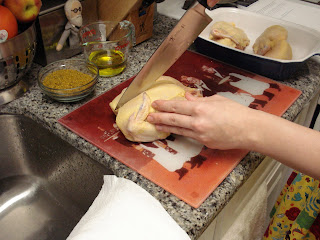
SO. Hen-splitting time. It's time to deal with the fact that this used to be a relatively cute, fluffy animal, and split the ribcages from front to back. Also, big knives + slippery chicken skin = heightened risk of chopped fingertips. Gah. (Also, I'm pretty sure this is not the knife I'm supposed to use.) Here we go:


Yet MORE win! No fingertips missing, and you now have four halves of Cornish hen! Just so you know, the most unsettling part is the sound of cracking bones. Like a... well, like a set of tiny cracking ribcages, really.

Rub the spice mixture on the hen halves, then pour on olive oil, "turning to coat." I'm using 1/2 a cup instead of a full cup, as that's all that's left in my kitchen! Unsurprisingly, it is more than enough to coat the birdies. Now cover up, pop in the fridge, and... do something else for three or four hours. My personal choice is to take a shower. It's almost 100 degrees out today, and I left the apartment for all of ten minutes, leaving me pretty much drenched. This is one of the few days in my personal experience that can be unequivocally described as "oppressively hot."

Of course, showering only takes 10 minutes, 30 if you count makeup and hairdrying as part and parcel of a "shower." So... You put the hens in the fridge to marinate at 3:00. What with one thing and another, an hour and a half passed [name that awesome book/movie (although this line says "three years" instead of "an hour and a half," and isn't in the movie)]. Now you still have at least another hour and half to go. Why don't we go ahead and make the basting sauce a little early? Why not, right? Because the onions might become soggy in the soy sauce, you say? Well, forget you; they'll get soggy when they roast. So there. Stop being so difficult.

I could not find spring garlic, which is essentially garlic greens, according to Whole Foods' website. I will be using just a bit of garlic powder, hoping that will make up for the difference. Whatever. Here's a picture of an allium plant from the park near me to distract you: (Allium is the onion and garlic genus.)


I DO have scallions. This recipe only calls for two, so make sure to use the rest of the bunch in a salad for later: A wasted scallion is a tragedy.

So here we have our basting sauce:


I have a sneaking suspiscion that I was supposed to chop the scallions more finely, but, again, whatever. (Can you tell that heat makes me apathetic and lethargic?) However, I am happy to report that, while back in the kitchen slicing the scallions, my olfactory senses played host to a wonderful aroma of Indian/Moroccan/Italian spices. Heavenly.


Time to take the hens out of the fridge and pre-heat the oven! The actual cooking won't take too long, so you may want to go ahead and cook your couscous now (it will stay hot) if you're like me and can't so much "multi-task" as "burn everything." Here we go!


I don't know about Courtney's neck of the woods, but here in NYC, a HUGE downpour of atmosphere-cooling rain just started right on cue with my cranking up the oven to 400 degrees. Merciful. So, the oven is heating and the hens are waiting...


As you can see, our sous-chef takes exception to the use of so many non-feline-friendly spices, rendering him ineligible to sample this dish. He is not shy of demonstrating his displeasure:


While the hens are cooking, you shouldn't ignore any strange burning smells. It may be the bottom layer of your couscous burning. Because you can't cook rice-like dishes without burning them, as previously stated, about 85% of the time.


After 25 minutes (we're cooking some chicken breasts along with the hens, for eatin' later this week) (also, our hens are slightly larger than the recipe calls for) of cooking the hens in the top third of the oven, start basting! Before you baste for the first time, eyeball the juices coming out of the hens to see if they're starting to turn clear-ish. They ought to, by this point. If you're super lucky, you may even burn your thumb while cutting into the crease between the thigh and the body to check the juices, just like ME! Twice! (For real. 400 degree steel on the skin? OUCH.)


The paper's recipe calls for two bastings during a seven minute period, but, again, just eyeball it. When it looks done, take the hen out of the oven and let it sit for about 10 minutes. Mine are taking a little longer, by that timing, probably because of the size and extra meat in the stove. Correction: Make that a LOT longer. So far, I put the hens and chicken breasts (in different pans) in for 25 minutes; then 5 minutes. Then I took the chicken breasts out, mostly done. I set the timer for another 5 minutes. I just checked them again. Still not done. This leads me to conclude that Cornish Hen Is Tricky. Courtney will be familiar with this particular theorem, as she witnessed a similar timing debacle on Easter weekend. I'm beginning to suspect that my oven runs cooler than it purports to... and that it's a good thing that Kenny ordered Chinese food for himself tonight. So, we're waiting... we're waiting...


We're filing our nails... we're waiting...

And, FINALLY, WE'RE DONE!


(I think a good way to eyeball this is to let the spices and onions and stuff get nice and browned before you cut into the thigh to check the doneness for the first time.) (Also, I'd like to point out that the flash renders the change in color almost indecipherable. In real life, these are a nice, toasty brown.)


Let's dig in! Most important taste revelation: I'll admit that I was skeptic about a basting sauce that combined Worsterchire sauce and soy sauce. I mean, who does that??? Well, smart people, apparently, because it smells YUMMY. Which is fitting, this being the Yum Yum Cooking Club, and all.


All in all, I solidly recommend this recipe, if you have time and a patient cooking/dining partner! And a sous-chef who won't give you the stink eye when he's not allowed to sample.