Friday, September 18, 2009
Ali's Kitchen: Apples For Rosh Hashanah
Tuesday, September 8, 2009
Ali's Kitchen: Anniversary Special: Baking
Tuesday, August 4, 2009
Friday, July 31, 2009
Ali's Kitchen: Oui, oui, Ratatouille!
RATATOUILLE
Saturday, July 18, 2009
Ali's Kitchen: Fresh Fig Scones
Wednesday, June 17, 2009
Ali's Kitchen: French Fries Substitute

Wednesday, June 10, 2009
Ali's Kitchen: Consume Some Time-Consuming Peach Pie
Wednesday, April 22, 2009
Ali's Kitchen: Potato and Onion Gratin with Coconut Milk and Curry
First, I found this, which doesn't involve coconut milk, but seemed as though it would be complementary. (The mint in those beef patties is what makes it, by the way. The cumin overwhelms them a little so much so that the coriander isn't really apparent, but the mint is just the perfect little pop.)
Then, I realized that coconut milk is "milk," so why not treat it as such and make something of a gratin? And, since we're at it, why not throw some curry in there? Just because. Curry is awesome. (In this case, it was curry pounder, but I suppose I could also have used some Thai red curry sauce.) So we came up with:
- Preheat the oven to 400.
- Slice 2 small yellow onions into thin rounds and saute in a little vegetable oil, just until brown around the edges. Set aside on paper bags or paper towels to degrease a little.
- Mix together a teaspoon of minced garlic (about 1 clove, if you're using fresh because you don't mind having stinky little fingertips), the coconut milk, 1/2 - 1 tsp curry powder, and a pinch of salt. Set aside.
- Slice 2 large (Russet or other baking) potatoes into thin rounds.
- Layer the onions and potatoes in a greased baking dish (onions all in one layer, then potatoes on top; or onion/potato/onion/potato, up to you). Pour the coconut milk mixture over the top and pop it in the oven for and 1 hr 20 min, approximately. Just until the top is nice and crispy and brown.
Friday, March 20, 2009
Ali's Kitchen: Cupcakes on the Second Try
Tuesday, February 17, 2009
Ali's Kitchen: Chicken Breasts With Goat Cheese and Sundried Tomatoes
- chicken breasts
- (herbed) goat cheese (or ricotta)
- sundried tomatoes
- olive oil
- your favorite herbs, dried or fresh
I'll just bet you have some sundried tomatoes in your pantry somewhere, either dry-packed or oil-packed. And I know you have olive oil and dried herbs. And I'm just willing to bet that you have some boneless, skinless chicken breasts in your fridge somewhere. This recipe really rests on whether you have some sort of smashable, whippable cheese (which is not cream cheese, for goodness' sake). For the sake of argument, let's say you do. Alrighty then.
1. Rinse and dry your tomatoes (this may follow steeping in warm water if they're dry-packed), then chop coarsely.
2. Depending on how many tomatoes you decide to chop up, plunk a proportional amount of your cheese of choice into a medium bowl. Adjust the portions to your personal tastes; I used roughly 50% more sundried tomatoes than goat cheese.
3. Mix the tomatoes, cheese, a healthy drizzle of olive oil, and a healthier dusting of your herbs (mine was simply basil since I used herbed goat cheese) in the bowl, smooshing and wooshing about until it's somewhat mousse-like, and the entire mixture looks orangey with chunks of red - no pure white from the cheese should be left.
Le yum yum!
Thursday, December 25, 2008
Ali's Kitchen: Swedish Holiday Treats
I am ALL about my [admittedly meager] Swedish heritage this year. I may only be about 1/16, but I know the name of my most recent Swedish ancestor (Maria Pollan, née Larson), so that counts for something, I figure. My Nana, who has had a very tough year, always identified with her Swedish heritage, if not necessarily in the kitchen. It'll be a fun, and for me meaningful holiday exercise to attempt a few traditional Swedish recipes.
A word about Swedish holidays:
St. Lucia's Day
Lussekatter
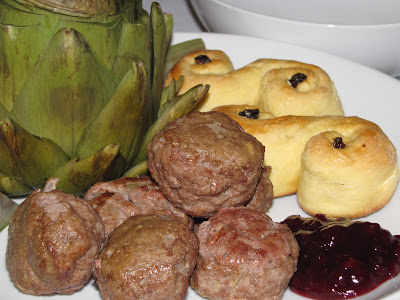
On the feast day of St. Lucia, little Swedish girls (and Norwegian girls and Danish girls and Italian girls and a bunch of girls) dress up in white gowns with red sashes, wear wreaths with burning candles on their heads (yeah, really) and pass out the Christmas presents. You know this if you, like me, had the American Girl Doll Kirsten Larson, who was a plucky Swedish immigrant in 1854 (or something). Kirsten had a St. Lucia's Day outfit, and I think the outfit even came with a little plastic lussekatt, the saffron bun baked and eaten on St. Lucia's Day night. It all sounds terribly cute until you consider the fact that the wreath with candles is supposed to symbolize the *fire that wouldn't burn St. Lucy after she was sentenced to death*. Isn't that festive? I pulled the below recipe from a website to which I will NOT link, because they had all kinds of typos and it was just generally an "off" recipe, so I had to modify.
Jul/Midwinter
Glögg
The Yule is celebrated on December 24th in Sweden, though it's also tied to the old Germanic pagan festivals related to the Winter Solstice on December 21st. This is the day when Swedes tie one on and really enjoy their version of spiced mulled wine: glögg (pronounced something like "glug"). There are so many various recipes for glögg that you can feel free to assemble the main ingredients and use them in whatever proportions please you best.
Any Swedish Holiday At All
Köttbullar
Swedish. Meatballs. 'Nuff said. Always, always served with lingonberry preserves. Seriously, in Sweden if you try to eat köttbullar without lingonberries? They will arrest you and beat you. I've provided the classic preparation from Fresh Direct, but I'll outline my method, too.
LUSSEKATTER
(Saffron Buns)
INGREDIENTS
1/4 teaspoon saffron threads 1 cup milk 1 tablespoon yeast 1/2 cup sugar 4 ounces (1 stick) unsalted butter 5 cups all-purpose flour 1 teaspoon salt 2 large eggs, beaten 1 beaten egg white for egg wash
PREPARATION
Pound saffron threads to break down strands. (Ali note: Or just tell the people reading your recipe to get saffron powder, jeez.)
In a small saucepan, heat milk to lukewarm.
Mix yeast with 1/4 cup milk and 1 tablespoon sugar. Set aside.
On low heat, melt butter in saucepan with milk. Add crushed saffron. Let cool.
In large bowl, mix together flour salt and remaining sugar.
Stir yeast into cooled milk mixture. Mix into dry ingredients, beating to mix well. Add beaten eggs.
Knead in bowl for 5 - 7 minutes. (Ali note: Kneading in the bowl is somewhat confining. After the eggs are mixed in well, feel free to jump right to your floured board, or counter, as the case may be.) Turn onto floured board and knead another 7 - 8 minutes. (Ali note: If it's sticking to your little fingers, try adding a bit more flour to your board or counter; that’ll mix in and firm up the consistency a little. Conversely, if it's too DRY to stick to your little fingers, sprinkle some water on as you knead 'til it's about the right texture - something like Play-Doh.) (Don't forget to wash your hands before you start this recipe, including under your filthy little fingernails, you scab.)
Put dough in lightly greased bowl, turn to coat all sides, cover and put in warm, draft-free place to rise for about 1 hour.
When dough has risen, knead lightly to push out air and divide into small pieces (about 10-12). (Ali note: Whoever wrote this recipe was high if they thought this amount of dough makes 10-12 of these things, the size of which would cook in 15 minutes. I ended up with closer to 18, and still needed a little longer in the oven.)
Using the hands, roll each small piece into a strip about 8 - 10 inches long. Shape each strip into an 'S' or a figure 8. (Ali note: For authentic look, place a raisin or currant in the dimples of each bun.)
Place on lightly buttered cookie sheets. Cover with clean cloth and let rise again, about 1 to 1 1/2 hours.
Preheat oven to 375°F.
When dough has risen, brush lightly with egg white.
Bake in preheated 375° F oven for 15 minutes, or until lightly browned (which was a bit longer than 15 minutes).
Let cool on wire rack.
GLÖGG
(Um... Glögg)
As noted above, you can make glögg in nearly any way you choose. This is my favorite amalgamation:
INGREDIENTS
1 bottle dry red, such as Cabernet Sauvignon
1 cup brandy
3-4 cinnamon sticks
6-8 cloves
1-2 teaspoons ground cardamom (ideally you use 3-4 whole caramom pods, cracked, but good luck finding those in most grocery stores)
1 tablespoon dried orange peel (or the peel of 1 whole orange)
1/3 cup sugar (ideally brown, but if you're scrimping and just have white, go for it!)
Currants or raisings
Almond slivers
PREPARATION
Simple: Heat. On the stove. For at least 45 minutes. Don't let it reach 170 or so (that means keep it just at steaming and below simmering), unless you want nonalcoholic glögg. A clean meat thermometer is handy for this purpose.
Put a small handful of currants (or raisins) and almond slivers at the bottom of each glass.
Pour the glögg into your glasses through a sieve to strain out the cloves and such, and enjoy.
Skål!
KÖTTBULLAR
(Swedish Meatballs)
I made this with 2 lbs. ground beef (you can also use veal with the beef, about 1/3 to 1/2 the total amount of meat; that's how the restaurants usually do it) instead of 1 1/3 lbs., which is what the original recipe called for. Watching *me*, the literature nerd, try to figure out that sort of conversion? Must have been priceless. I had to appeal to my civil engineer father for guidance. This is what he came up with:
INGREDIENTS
1/2 cup plain breadcrumbs
1/2 cup milk
1 medium yellow onion, finely diced
1 egg plus 1 egg white
2 lbs. pounds lean ground beef (But for goodness sake, not too lean.)
1/2 tsp salt
1/4 tsp pepper (Most recipes call for white pepper, but this one doesn’t differentiate; I used white)
1/2 tsp allspice
1 tbs butter
1 tbs extra-virgin olive oil
PREPARATION (The "real" way)
Soak breadcrumbs in milk for 5 to 10 minutes until the liquid is absorbed.
To a bowl add onion, egg, ground beef, soaked bread crumbs, all spice, salt and pepper.
Mix all the ingredients together with your hands and shape the meat mixture into small balls, less than an inch in diameter. If the mixture starts to sticks to your hands, wet them with cold water.
Heat a skillet with butter and extra virgin olive oil.
Sauté the meatballs in 3 or 4 batches, turning them frequently to keep the meatballs from sticking. Drain them on paper towels.
Drain the excess olive oil and scrape off and discard any browned bits of meat that may be sticking to pan after the meatballs are done.
To the same pan add butter and flour and stir until it browns.
Quickly add a can of beef stock and bring to a boil, stirring constantly until gravy thickens.
Remove from the heat and serve immediately with the meatballs.
PREPARATION (The weenie way)
Preheat the oven to 400°F.
After you've formed the meatballs as described above, place in a lightly greased, uncovered Pyrex dish.
Cook for about 10-20 minutes, depending on the size of the meatballs; eyeball it and do a touch-test to test for doneness. Rotate halfway through so the entire sphere gets browned as it would have in a frying pan.
Remove from pan, and drain on paper towels; keep warm after draining.
Use pan scrapings to make gravy as described above, adding extra beef broth or stock to increase volume as necessary.
(Sorry for the freaky lighting. Still getting the hang of this new camera!)
Enjoy your Swedish feast, you crazy Vikings! } :- )
(That's clearly a Viking helmet, BTW.)
(Shaddup.)
Wednesday, November 19, 2008
Ali's Kitchen: Potato and Leek Gratin With Cumin
1 tablespoon extra virgin olive oil
1 pound leeks, white and light green parts only, cut in half lengthwise, sliced and rinsed of sand
Salt and freshly ground pepper
1 teaspoon cumin seeds, lightly toasted and crushed in a mortar and pestle or a spice mill (I had cumin seeds as well as ground cumin, but not a mortar/pestle or spice mill. I just used the ground cumin.)
2 pounds russet potatoes or Yukon golds, peeled if using russets, scrubbed if using Yukon golds, and sliced 1/4 inch thick (I'm using red potatoes because for some bizarre reason, that's all the grocery store had. I think I also bought more than 2 lbs - our grocery doesn't have a scale, oddly enough - because this practically overflowed my 2.2 lb casserole.)
3 ounces Gruyère cheese, grated (3/4 cup, tightly packed)
2 1/3 cups low-fat milk
2. Heat the remaining olive oil in a wide, heavy nonstick skillet over medium heat and add the leeks. Cook, stirring often, until tender, for about 5 minutes. Add 1/2 teaspoon salt and freshly ground pepper to taste and stir in the crushed cumin seeds. Stir together for half a minute and remove from the heat.
3. Place the potatoes in a large bowl and season generously with salt and pepper. Add the leeks mixture and half the cheese, and toss together. Arrange in the baking dish in an even layer. Pour in the milk.
Place the baking dish on a baking sheet and place in the oven.
There you have it! In retrospect, I would add that:
- Putting a cookie sheet under the pan is helpful, in case the milk boils over in your small casserole;
Sunday, November 16, 2008
Amsterdam Vacation Culinary Roundup
Zuurklooschotel met riesgling
("Sauerkraut with Riesling" - Salted pork, bacon, sausage, frankfuter and rozeval potato)
Jet lagged on our first evening, we ordered room service in. And what pleasantly surprising room service it was. I think those oval-shaped things are the "bacon," since Europeans are weird like that. The sausage was absolutely succulent, and the "frankfurters" were a far cry from Nathan's Famous. This meal was so delectable that I was forced to admit my non-abhorence of sauerkraut. I can't even tell you about the mustard. OH MY GOD, THE MUSTARD. However, it was the SALT, not the mustard, that swelled my eyes up to veritable capsules the next morning. Worth it, but I really should have known better.
FYI, they sell beer here that's up to 9% alcohol.
I don't know if it's the increased alcohol content or the supposedly-cleaned-daily pipes that lead to the superior taste and easier headache ratio (said the gal who gets a headache from one beer, normally).
Another thing they do differently here: Goat cheese.
Yet ANOTHER thing they do differenetly here. Fries. With MAYONNAISE:
That shite is disconcertingly tasty, but I suspect only when it's "real" mayonnaise. None of that bottled BS.
Here we have some cheese. Didn't get the name of the cheese - just "Dutch cheese," aged and young. With mustard. OH MY GOD, TEH MUSTARD.
One night we had Indonesian for dinner. This is a prevelant cuisine in the Netherlands, due to the fact that the Dutch colonized Indonesia for some inhumane amount of time. I can never remember if it was four or six hundred years, and cannot be bothered at this moment to Google the fact.
This is a rijsttafel:
Ours consisted of - vaguely from back row to front row, left to right - beef satay, spiced chicken, spiced beef, spiced fish (with hidden chilis, OMG), vegetables in coconut milk, vegetables in coconut sauce, [second row] fried chicken (wrapped in some kind of dark pepper skin), cucumber salad, shrimp crackers, something I didn't catch, soy bean paste. (And steamed rice in the front there.)
All I have to say is that HOLY CRAP, INDONESIAN FOOD IS GOOD. And SPICY.
And now, for the Dutch master work: PANNENKOEKEN!
Those crazy Europeans and their "bacon." Which is really "pancetta." Pssh.
And you know what? Our last night we felt entitled to be a little lazy, so we camped out at the hotel's restaurant, which conveniently showcased another couple of Dutch strenghts: Seafood and game.
My favorite thing about Amsterdam, just discovered since I've never been before, is that you can walk anywhere and everywhere. So it makes a whole bunch of sense to me why their food is so rich and yummy, and why they're still so comparatively slim. The one Dutch treat I didn't get to try was a herring roll, with pickles and onions. Granted, working at a Swedish restaurant gave me more than enough exposure to herring (ugh) and I know that I actually don't care for it, but herring here would have been like, say, blood sausage in the U.K. Oh well. Next time!
Tuesday, October 28, 2008
Leftovers Followup: Poule Au Pot Ingredients
1. Prep the chicken as you wish (I'm stuffing with goat cheese, and sprinkling on thyme, salt and pepper).
2. Chop the vegetables (except for the leeks) into about 2-inch chunks. Plop in a casserole/roasting dish and pour in just enough chicken stock to cover the bottom of the casserole. Cover with aluminum foil (or a real casserole cover, if you're fancy like that).
3. Pop chickies and veggies on the top oven rack at 375, and check for doneness in about 25 minutes. That's a pretty good mass cooking in the oven at one time, so don't be surprised if things still need 10-20 minutes more, depending on: how large an amount of leftover veggies you had; how big and how many your chicken breasts are; and how heavy your casserole/roasting dishes are.
Intermission: Play with your new camera.
Another intermission option is to accidentally burn your forearm on the 375 degree oven when lifting the veggies out to check for doneness. Ouch. I mean, really. Ouch.
4. When chicken and vegetables are done, chow down. If one is done way before the other for some reason, no sweat off your back. Take it out, keep it covered, and pop back in for a sec before you feast.Le yum yum for le cheap cheap! Le win-win.
Saturday, October 25, 2008
Ali's Kitchen: Poule Au Pot
INGREDIENTS
4 pints of chicken stock (possibly more: enough to submerge the ingredients in a large, heavy pot)
2 leeks, just the whites and light-greens, halved crosswise and lengthwise (remember: leeks are dirtier than a teenage boy's imagination, so wash, wash, wash in all those little layers)
1 medium white onion, quartered
1 large turnip, peeled and quartered
2 parsnips, peeled and halved crosswise
2 carrots, peeled and halved crosswise
2 celery stalks, cut into 2-inch pieces
Salt & pepper to taste (start with no salt if you're using canned stock/broth)
Bouquet Garni: 3 parsley springs, 1 large bay leaf, 3 springs of thyme (1-2 tsp dried), 1 celery stalk cut in half. Tie all this together with kitchen twine (or the parsley, if it's a little old and not so crisp), or just throw it in there, and strain the broth when you're serving later, so you don't end up munching on the parsley or bay leaf.
Approx. 8 chicken pieces, or 3-4 boneless, skinless chicken breast halves, cut into 2-inch chunks
PREPARATION
1. In your large pot, bring the chicken stock to a boil. If using boneless, skinless chicken breasts, boil your vegetables and Bouquet Garni for about 20 minutes, or until just slightly tender.
2. Add the chicken breasts, bring back to a boil, then reduce to a SIMMER (not boil, or the chicken will get tough), partially covered until the chicken is cooked through, about 5-10 minutes (this is obviously contingent on whether your chicken has bones, and/or how small the breast chunks are which you've cut; check doneness often so as not to overcook).
Serve in a shallow bowl with your favorite moisture-absorbing carbohydrate (for instance, a parbaked ciabatta loaf that needs to get out of your freezer before it's completely useless). Make sure everyone gets a little of everything in his or her bowl.
THIS RECIPE'S VERSATILITY MAKES IT GREAT!
* If you can't find "stock," just use broth.
* You can use whichever chicken parts you prefer. If using thighs, or parts from a whole chicken, boil these for about 10-20 minutes first, depending on their size, before you start cooking the veggies.
* The beauty of these particulary root vegetables is that they don't turn mushy like potatoes if you need to cook the chicken a little longer than you thought.
* If you don't have one big pot, you can cook your veggies in one pot and chicken in another, with a Bouquet Garni for each.
* You can prep the veggies ahead of time and cover, immersed in water:
Post script: It is with much thanks that we bid adieu to our beloved Sony point-and-click and welcome to blogland our brand new Canon, hereafter christened Carlita Canon.
Le meow meow.
Sunday, September 7, 2008
Ali's Kitchen: Classic, First-Anniversary-Friendly White Cake
White Cake, Joy of Cooking, page 937
Have all ingredients at room temperature, 68 to 70 degrees F. Preheat the oven to 375. Grease and flour three* 8x2-inch round pans or line the bottoms with wax or parchment paper. Sift together twice:
3 1/2 cups sifted cake flour**
1 tablespoon plus 1 teaspoon baking powder
1/2 teaspoon salt
Combine:
1 cup milk
1 teaspoon vanilla
1/4 teaspoon almond extract (optional)
In a large bowl, beat until creamy, about 30 seconds***:
1 2/3 cups sugar
Add the flour mixture in 3 parts, alternating with the milk mixture in 2 parts, beating on low speed or stirring with a rubber spatula until smooth and scraping the sides of the bowl as necessary. In another large bowl, beat on medium speed until soft peaks form:
8 large egg whites
3/8 teaspoon cream of tartar
Gradually add, beating on high speed:
1/3 cup sugar
Beat until the peaks are stiff but not dry****. Use a rubber spatula***** to fold****** one-quarter of the egg whites into the butter mixture, then fold in the remaining whites. Divide the batter among the pans and spread evenly. Bake until a toothpick inserted into the center comes out clean, about 25 minutes. Let cool in the pans on a rack for 10 minutes. Slide a thin knife around the cake to detach it from the pans. Invert the cake and peel off the paper liners, if using. Let cool right side up on the rack. Fill and frost as desired.